
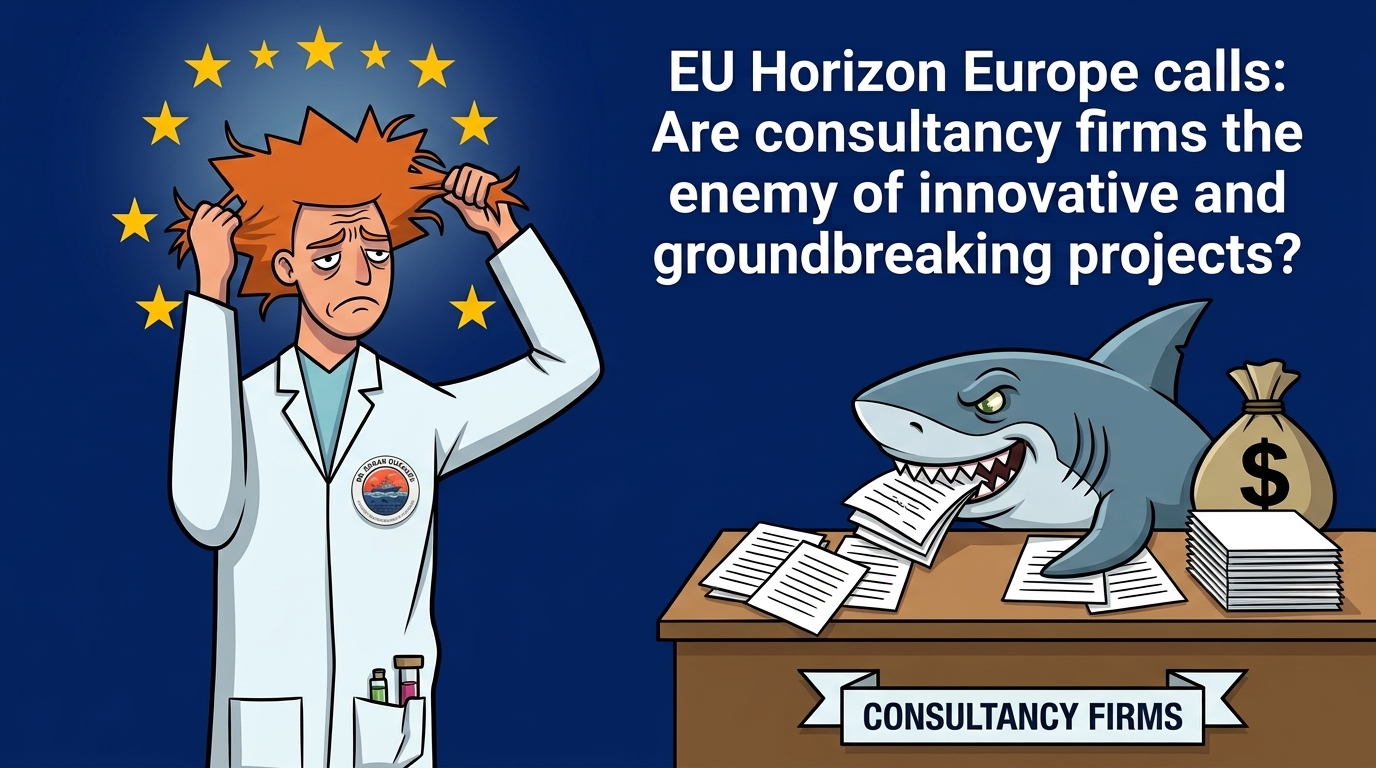
A few weeks ago I was approached, unsolicited, by a company offering to build me into a Horizon Europe consortium. The email was templated, addressing me by the wrong title, and it took two follow-ups before the actual project documents arrived. When they did, the picture became clear: a topic identified from the Horizon Europe work programme, a partner-search table with empty slots to fill, and a fee schedule. An upfront fee, paid by the coordinator and recovered from partners on submission. A success fee, calculated as a percentage of the grant each partner requests, paid out over the life of the project if the proposal succeeds.
Nothing about this is illegal, and such brokerage services are a normal, tolerated part of the Horizon Europe ecosystem. But it crystallised something I think is worth saying plainly, because I don't think it's said often enough: this is the wrong order of operations for science, and it is one of the quieter reasons European research keeps producing more projects than breakthroughs.
The order that should hold
A research project should begin with a need identified through discussion among researchers: people who may or may not already know each other, but who are talking to one another about a real, unresolved scientific problem. Out of that discussion, a group forms around a genuine question. Only then should that group look for the call best suited to answering it. The funding follows the idea.
The model I encountered inverts this entirely. A call is identified first, for its funding envelope and its topic fit. A consortium of near-strangers is then assembled, quite literally, from a spreadsheet of “searching” and “covered” roles, to satisfy the call's structural requirements: enough countries, enough partner types, enough boxes ticked. Only afterwards is a scientific project built to fit the assembled group and the available money.
This is not a fringe practice. It is a business model, openly advertised, with a fee card attached.
Why the order matters
This isn't merely a matter of taste. There is empirical evidence for why it matters.
Enger and Gulbrandsen (2020), studying how ICT consortia in Horizon 2020 actually form, found that well-functioning projects begin with a small core group of organisations that already share prior experience, developing the scientific concept together before recruiting further partners, chosen at that point for expertise and genuine relational fit. Newcomers with no relational ties or track record are, in their words, “seldom included.” That is close to the opposite of assembling a consortium from a partner-search table of strangers.
Separately, Wang, Veugelers and Stephan (2017) showed that funding and evaluation systems built around short-term, low-risk bibliometric indicators are systematically biased against the kind of high-novelty, high-risk research that goes on to have the greatest long-term impact. A call-first model, optimised to satisfy a topic's stated criteria rather than to pursue a genuinely disruptive idea, is almost engineered to produce exactly the safe, fundable, forgettable science this bias already favours.
Put the two together and the mechanism is clear: consortia built to fit a call, by people who don't know each other and have no shared question, tend to produce fragmented projects: each partner quietly doing their own small piece of work, with little real data integration between them, rather than the joint, European-scale results that Horizon Europe's own ambitions call for. That is not a minor inefficiency. It is a slow leak of European public funding into projects that were never going to be more than the sum of their disconnected parts.
What I'd rather see
None of this is an argument against collaboration, against consortia, or even against paid administrative support for proposal writing: that support has a legitimate place when it follows, rather than leads, the science. It is an argument for restoring the order: idea first, call second. Fewer projects, more ambition. Consortia built on a shared question and, ideally, a working relationship, not assembled to specification like parts for a machine.
The European research system does not lack money or infrastructure for this. It lacks the discipline, at every level from funders to brokers to researchers ourselves, to insist that the science comes first.
- Enger, S.G. and Gulbrandsen, M. (2020) ‘Orchestrating collaborative projects: Inside ICT networks in Horizon 2020’, Science and Public Policy, 47(3), pp. 396–409. doi.org/10.1093/scipol/scaa021
- Wang, J., Veugelers, R. and Stephan, P. (2017) ‘Bias against novelty in science: A cautionary tale for users of bibliometric indicators’, Research Policy, 46(8), pp. 1416–1436. doi.org/10.1016/j.respol.2017.06.006